How to Reconnect With Your Body When You've Quietly Lost Touch With Parts of It
by Char
|


If you're trying to figure out how to reconnect with your body, you're probably already in the experience of it. The faint sense that something is off. The feeling that you're walking around in a body that's working, but not quite yours. The strange realization that you don't actually know what your lower back, your hips, or your jaw feel like right now.
This is a guide to the slower, quieter version of body reconnection. No weekend retreat, no breathwork ceremony, no big breakthrough moment. Just the daily, boring, genuinely useful work of meeting the parts of yourself you've been quietly ignoring, and what it actually takes to come home.

You Can Be "In Your Body" and Still Skip Whole Rooms
You can be moving, breathing, doing Pilates, reconnecting with your belly breath, actively working at being back in your body for years, and still have entire regions of yourself that have gone quiet. Your body is technically working. You're functional. You'd never describe yourself as numb. But there are neighborhoods of your own physical self that you haven't visited in years.
I learned this in the most ordinary way possible. I was in a reformer Pilates class a couple of weeks ago, doing this movement where you're on your back with your feet on the foot bar and you lift your hips. The teacher was asking us to do it step by step: lift your tailbone first, then your lower back, then roll up. I was trying. I really was. She came over, gently corrected my form, and we moved on.
At the end of class, I went to her and asked for tips on my lower back flexibility. I told her I'd been working on it for a while and was still encountering issues. And she said something I haven't stopped thinking about since: my spine had the potential flexibility. My spine could do it. But I didn't know where my lower back was. It was a problem of awareness, not flexibility.
I just stood there, quiet, because I didn't know what to do with that. How do I not know where my own lower back is? What does that even mean?
The interesting part was that she wasn't surprised. She told me it's okay, that a lot of people have this issue, and that the lower back is definitely a place people leave first. She didn't just mean me. She meant a lot of us.
The work of body reconnection is small and quiet. It's the daily act of visiting parts of yourself you've stopped speaking t
What "Feeling Disconnected From Your Body" Actually Looks Like
When most people search "feeling disconnected from your body," they're picturing something obvious. Dissociation. Numbness. A sense of floating outside themselves. And those experiences are real and worth taking seriously.
But the version I want to talk about is much subtler. It's the version most women don't even know they're living in. Those big sentences like "you're not in your body, you're in your head, get back in your body" feel disconnected themselves when you hear them at yoga or Pilates. They're too general to land.
Signs that you're disconnected from parts of your body without realizing it:
✨ You can't easily picture or sense certain regions (your hips, your lower back, your jaw) without consciously reaching for them
✨ You're surprised when teachers or therapists point out tension or imbalance you didn't know was there ✨ You feel "fine" most of the time but struggle to describe how your body actually feels
✨ Pain or stiffness shows up and seems to come from nowhere
✨ Movement classes leave you confused about whether you're doing something "right"
✨ You've been actively working on reconnection and still discover areas you've been bypassing
None of this means anything is wrong with you. It means you're a regular person who learned, somewhere along the way, to dim the lights in certain rooms. And the body, being the patient and adaptive thing that it is, complied.
Why Parts of Your Body Go Quiet in the First Place
There's a real, science-backed concept underneath all of this. It's called interoception, and it's the sense that lets you perceive what's happening inside your body: your heartbeat, your hunger, your breath, the tension in your shoulders, the warmth in your hands.
According to Cleveland Clinic, interoception is the awareness of your body's internal senses or signals, and it's a learned skill that develops as you grow. Some people have a stronger interoceptive sense than others, and certain experiences can quietly turn it down.
Researchers have found that people with anxiety, eating disorders, depression, and trauma histories often perceive their internal sensations differently, and many therapeutic interventions now focus on helping patients reconnect with their bodily sensations through mindful breathing or movement. In other words, body disconnection is a recognized phenomenon, and reconnection is a learnable skill.
But the why is the part I find most useful to sit with. Why does your lower back, or your jaw, or your hips go quiet?
Often, it's because that region was holding too much. The lower spine, hips, and pelvis carry a lot of weight, and I mean both kinds: the literal weight of being upright and the weight of carrying things in life you were never meant to carry. Caring for other people. Holding responsibility for too long. When that becomes too much, the body makes a quiet decision: if we're going to keep doing this, we're going to have to stop feeling this part. We're going to have to numb it so you can keep pushing through.
And it works. For a while.
The trauma psychiatrist Bessel van der Kolk, who wrote The Body Keeps the Score, has spent decades writing about how the body holds on to what the mind tries to leave behind. As he puts it, physical self-awareness is the first step in releasing what the body has been carrying. You can read more on his official site.
What Happens When the Body Stays Numb Too Long
I want to be honest about what can happen when this quiet numbing goes unchecked, because it happened to me.
The problem with the fog is that you can't grow in it. You can't really move well in it either, not in a way that's coordinated with the rest of your body. Things start to compensate. Other parts of your body start working harder to make up for the part that's gone offline. And eventually, something gives.
In my case, it gave as a disc hernia. When I went to see specialists, they told me that a lot of things had been compensating in my body for a long time. My thighs and glutes had been permanently contracted to compensate for the imbalance in my hips. And I hadn't even felt my hips slowly falling out of balance because that whole region was so numb. I ended up with injuries in several areas, all connected to one quiet problem I never noticed.
Before the hernia, my body had already made the decision to stop sending me signals from that region. It numbed the area so I could keep pushing through, keep functioning, until obviously I couldn't anymore.
That's what this protective mechanism costs you if it runs long enough. And that's why I want to talk about the time before the collapse, the period where things are just quietly numb and you don't know it yet.
How to Reconnect With Your Body (The Boring Daily Version)
Here's where most articles will hand you a list of breathwork sequences or yoga flows. I'm going to skip that, because I think the bigger problem is that we're approaching the whole thing with too much intensity, looking for a big shift when the body responds to something much smaller.
The actual practice of how to reconnect with your body is boring. I'll just say it. It takes very little time and very little space, and that's actually the point.
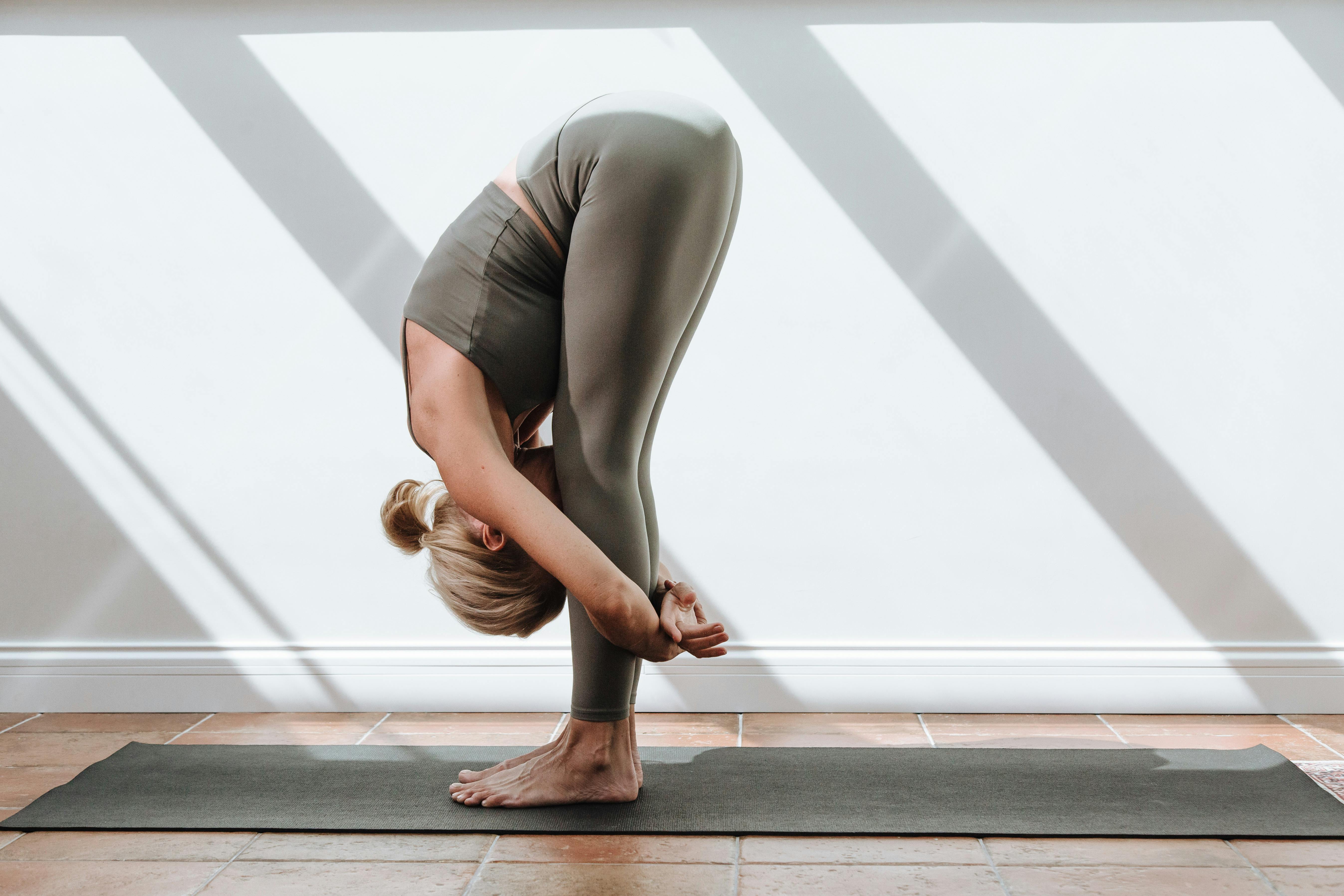
Here's what mine looks like after my conversation with the Pilates teacher. For my lower back specifically, I stand on my porch, put my hands on my lower back, and then very slowly round my spine down, one section at a time, until my hands touch my feet. Really slowly. One area of the back at a time. I use a mirror so I can see which part of my spine is actually moving and check whether my awareness matches what I'm seeing.
And I do it again. And again. Until I can tell, in real time, which part of my back is rounding. Upper back. Middle back. Lower back. Tailbone.
That's it. That's the work.
It doesn't take long. It doesn't require a specific environment. I can do it a few times a day. And that frequency is the whole point, because what builds awareness is repetition, not intensity.
How to Start If You Don't Know Where to Begin
If you want to try this for yourself, here's how to make it practical.
Pick one area of your body that needs more care. Just one. Don't try to reconnect with your entire body in seven days. That's really not how it works. For women who are often in their heads, the hips and jaw are common places to start. For me, it was the lower back.
Find a simple movement or check-in you can do several times a day. It doesn't have to be the spine-rolling exercise I described. It can be putting your hands on your hips and breathing into them for ten seconds. It can be unclenching your jaw and noticing whether you were holding it. The movement itself matters less than the act of turning your attention toward something you usually ignore.
Notice what's there, without trying to change it. Are those muscles present to you? Can you feel through them? Or do you have to mentally struggle to locate them? All of those answers are real information. None of them mean you're failing.
Expect it to be boring and do it anyway. Some days you're going to be really bad at it. That's fine. I thought I was more advanced than I am, and my Pilates teacher gently reminded me otherwise. That's not a failure. That's just where I am. There's room for improvement, and the work to get there is genuinely simple.
Why Slow Is the Right Pace for Body Reconnection
We want reconnection to feel like a montage. A few good cries, a journal, some yoga, and we're done. But how to come back into your body takes longer than that. And there's a real reason for it.
According to Harvard Medicine Magazine's reporting on interoception research, the brain and body are in a constant feedback loop, with signals traveling in both directions, and the practices that strengthen this loop tend to be the slow, repetitive ones like mindful breathing and body-based attention.
Translation: this cannot be rushed. You're rewiring how your brain and body talk to each other. That takes repetition. It takes patience. It takes showing up to a part of yourself over and over again, even when nothing seems to be happening.
But here's what I've found after three years of this work: even though I'm still far from where I want to be, I can see the benefits already. The awareness is building. Slowly. And once it starts to come back, it tends to keep coming back.
What Reconnection Actually Feels Like
People ask me what it feels like when a part of your body "wakes up" again. Most of the time it's a slow, low-grade oh. A sense that you can feel through a region you used to skip over. An ability to activate muscles you didn't know you had.
Sometimes what comes up is awareness you weren't expecting: a clearer sense of where pain lives so you can actually treat it or prevent it instead of being blindsided by it.
And sometimes, nothing comes up at all. And that's actually fine too. You may be doing this work to gain flexibility, or you may just be doing it to breathe into parts of your body that have been quiet for too long and feel them again. Either is real. Either counts.
There's nothing wrong with discovering new parts of your body you weren't really in control of at any age. You're allowed to still be arriving.
FAQ
What does it mean when you feel disconnected from your body?
Feeling disconnected from your body can mean many things. For some people, it's full dissociation, a sense of being outside themselves. For most people, it's subtler: a low-grade numbness in certain regions, an inability to easily sense parts of your body, or a feeling of going through the motions without being fully present. It often develops as a quiet protective mechanism when a region of your body was holding more weight, literal or emotional, than it could process.
How long does it take to reconnect with your body?
There's no universal answer, but most people who commit to a small daily practice notice subtle shifts within a few weeks. Deeper reconnection, especially with regions that have been quiet for years, can take months or longer. The pace is set by your body, not by you, and trying to rush it usually backfires.
Can I reconnect with my body on my own, or do I need a therapist?
Many people can begin the work on their own with simple awareness practices like the one described in this article. That said, if your disconnection is connected to trauma, chronic pain, or eating disorders, working with a trained somatic therapist or trauma-informed practitioner can make the process safer and more effective.
What's the difference between embodiment and grounding?
Grounding usually refers to a quick practice for returning to the present moment, often during stress or anxiety. Embodiment is the broader, ongoing relationship with your body, the felt sense of inhabiting it fully. Grounding is a tool. Embodiment is a way of being.
Why do I hold so much tension in my lower back?
The lower back, hips, and pelvis carry a lot of literal and emotional weight. They're load-bearing in every sense. Many people, especially women, hold tension here because the region has been quietly compensating for years. When you're not aware of it, other muscle groups start doing extra work to cover the imbalance, and that compensation can eventually lead to injury. Building interoceptive awareness in this area is often the first step in releasing it.
Can yoga or Pilates help with body reconnection?
Yes, when approached the right way. Movement practices that emphasize slow, mindful awareness, going step by step rather than pushing for performance, can be powerful tools for reconnection. The key is choosing a teacher who prioritizes how the movement feels over how it looks, and who can point out what you might be missing.
You May Like