Why Do People Look at Me? What Your Body Knows Before Your Mind Does
by Char
|


If you've ever walked into a room and immediately felt like every pair of eyes landed on you, you're not imagining things. Well, actually, sometimes you are. But that doesn't make it less real in your body.
The question "why do people look at me" tends to come with a knot in the stomach and a very specific kind of self-consciousness that's hard to shake. And what most articles won't tell you is that the answer has less to do with what other people are actually doing, and far more to do with how your nervous system is interpreting the situation. That distinction changes everything.
The Real Reason You Feel Like Everyone Is Watching You
Here's what most people get wrong: they assume that the discomfort of being looked at is about confidence. That if you just believed in yourself a little more, it would stop bothering you.
That's not how it works.
Your nervous system doesn't care about your affirmations. It cares about safety. And when you walk into a room and feel watched, your body is running an incredibly fast, subconscious calculation: Am I being evaluated? Could this affect my status, my belonging, my safety?
There's actually research on something called social evaluative threat that confirms this. Situations involving uncontrollable social evaluation (meaning: judgment you didn't ask for and can't control) increase cortisol levels significantly more than stressful situations without social judgment. In other words, your body reacts more intensely to being assessed by others than to many other types of stress.
So if you've ever wondered "why do people look at me and why does it feel so intense," know that your body is doing exactly what it was designed to do. It's scanning for threat. The problem is that sometimes it scans a little too aggressively.
Being Watched vs. Being Witnessed: A Distinction That Will Change How You Move Through Rooms
Not all attention feels the same. And I think this is where it gets really interesting.
Think of a moment where someone asked you a simple question, something like "tell us what you're working on," and you just... flowed. Your words were clear, your hands moved naturally, your breathing stayed steady. You were aware that people were looking at you, but somehow that awareness sharpened you instead of shrinking you.
Now think of another moment. Same type of question. Maybe even the same room. But this time your body stiffened. Your movements felt mechanical. Words came out faster than your brain could track. You stumbled, maybe stuttered, and you couldn't figure out why it was so different.
The difference? Being watched vs. being witnessed.
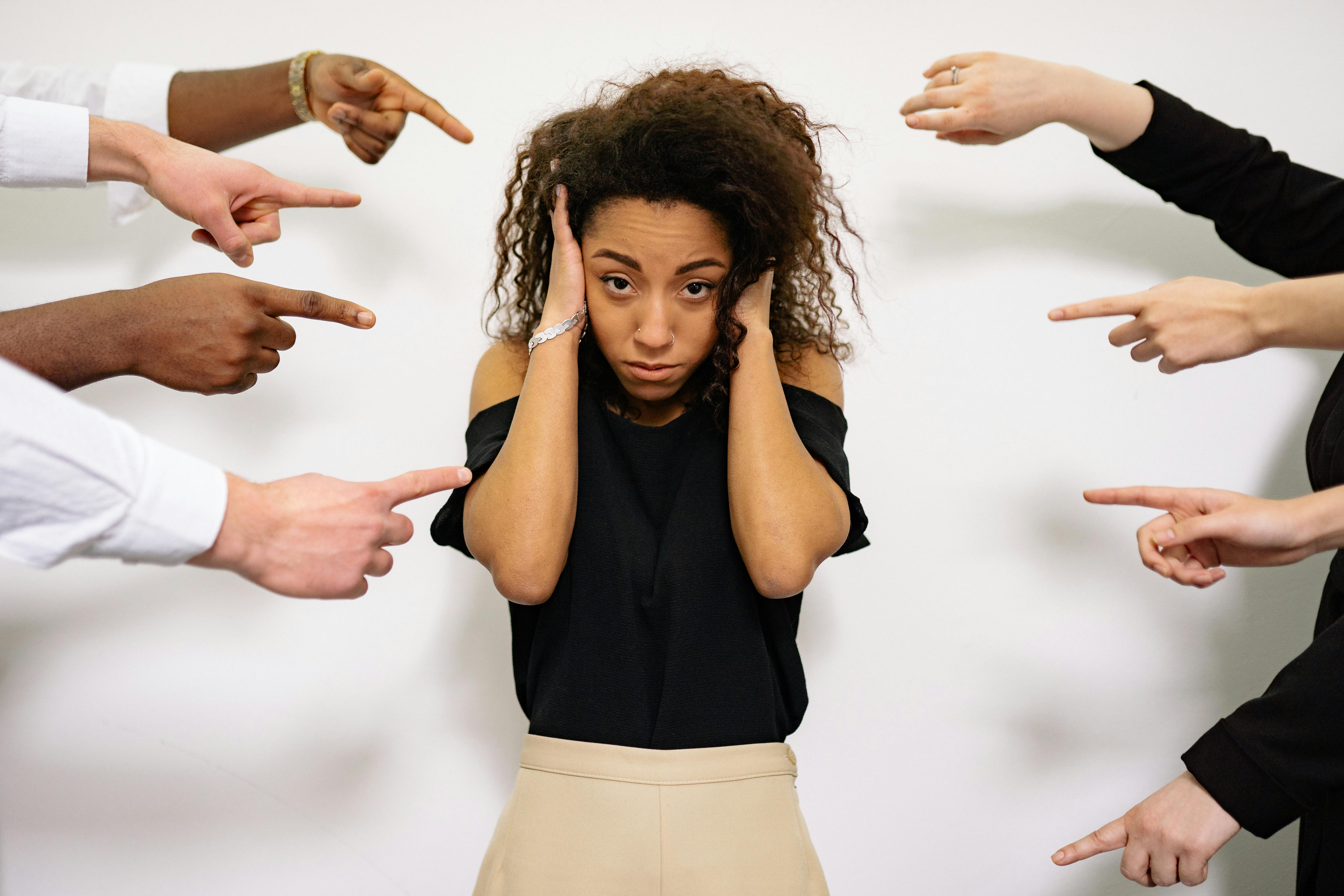
When you're being watched, your nervous system reads the room as evaluative. You become an object being scanned. The question underneath is: Am I being measured? Am I being compared?
When you're being witnessed, something entirely different is happening. The person looking at you is present with you, not above you. They see you as a subject, not an object. There's no consumption, no judgment. Just presence.

And here's the wild part: your body knows the difference instantly, long before your mind can name it.
What Happens in Your Body When You Feel Uncomfortable Being Looked At
If you've ever asked yourself "why do I feel uncomfortable when people look at me," the answer lives in your physiology.
When your nervous system picks up a signal of evaluation (even a subtle one), it triggers a cascade:
🔒 Muscles contract to protect you, especially in the chest, shoulders, and jaw
🫁 Breathing becomes shallow, which limits oxygen and makes your voice feel thinner
🧠 Your thinking speeds up as your brain tries to manage the perceived threat, which is why you sometimes talk faster than you can think
🪨 Movement becomes stiff and controlled, like you're performing instead of just being
And this isn't reserved for obviously hostile situations. You don't need someone to be openly criticizing you. Even a vague sense of I am being scanned is enough to set this off.
When you're being witnessed instead, the opposite happens. Your body softens. Your gestures sync with your words. Your breath deepens and matches your speech. You're still being seen, but your system isn't reading it as danger.
"You're still being perceived, but you're not being watched. Being watched pulls you slightly out of your body. Being witnessed lets you stay in it."
Why Do People Look at Me Weird? When the Room Is Neutral but Your Body Says Otherwise
Here's where we need to get honest about something. Sometimes, no one in the room is judging you. The room is genuinely neutral. But your body is reacting like you're under a spotlight.
That's not weakness. That's pattern recognition.
Your nervous system doesn't only respond to the present moment. It responds to an archive of everything that felt similar. The classroom where everyone turned to look at you after something embarrassing happened. The teacher who sighed when you gave a wrong answer. The offhand comment someone made about how you looked. The time you were compared to someone and came up short.
Your body remembers all of it. The tone of voice. The room temperature. The specific quality of silence that followed.
So when you walk into a new room and feel like people are looking at you weird, your system might be responding to a pattern, not the present. You might be deciding whether you're being watched or witnessed before the room has actually decided.
That's not a flaw. It's your nervous system doing its job with the data it has. But it does mean that sometimes the question "why do people look at me weird" is less about them and more about what your body is anticipating based on old experiences.
Why This Hits Differently for Overthinking Women
If you're someone who lives in your head a lot, who thinks carefully about what you're going to say, who sometimes thinks while you're talking (and then loses your thread entirely), this distinction between watched and witnessed hits different.
In conversation, you can manage perception with words. You have some control over the output. But in physical spaces, whether it's a yoga class, a dance studio, a gym, or even just walking across a room, your body is the language. There's no script to hide behind.
That's why the watched-vs-witnessed dynamic is especially sharp in movement spaces. If the room feels like it's watching, your instinct is to shrink your movement toward precision and control. Keep it small. Keep it safe. Don't draw attention.
But if the room feels like it's witnessing? Your movement can expand toward expression and curiosity. You take up space. You breathe. You let your body do what it actually wants to do.
So if you've ever noticed that you're stiff and mechanical in a class but expressive and free when you're alone in your living room, that's not random. It's your nervous system telling you where it feels safe.
How to Feel Safe Being Seen (Without Forcing Yourself Into Rooms That Aren't Ready for You)
Here's where I want to be careful, because I'm not going to tell you to "just put yourself out there" or "push through the discomfort." That advice ignores something important: sometimes rooms genuinely aren't safe.
Some environments are competitive, judgmental, or simply not designed to hold you well. Some studios, some classes, some social circles are truly not inclusive. And your body picks up on that accurately.
So step one is giving yourself permission to be discerning. Not every space deserves your vulnerability.
But step two is equally important: find the spaces where you do feel witnessed, and let yourself be there fully.
If right now your only safe space is you, alone, stretching in your living room or dancing in your bathroom or practicing something new where nobody can see you, that's a perfectly valid starting point, and a great way to build a foundation.
Here's what you can start doing today:
✨ Notice the shift. Next time attention lands on you and your body tightens, pause. Instead of labeling it "insecurity" or assuming you're being judged, ask yourself: Am I experiencing scrutiny, or am I experiencing presence?
✨ Let the answer be unclear. You don't have to figure it out in the moment. You can reflect on it later. The practice is in the noticing, not the solving.
✨ Protect your nervous system. If a room consistently makes you feel watched, not witnessed, you're allowed to leave. You're allowed to choose differently. Overwhelming your nervous system doesn't lead to growth. It leads to shutdown.
✨ Expand slowly from safety. Once you have your safe space (even if it's just you, alone), that becomes the base from which you can slowly, gently widen the circle. Maybe it's one trusted friend. Maybe it's a smaller class. There's no rush.
The goal isn't to become someone who doesn't care about being looked at. That's not realistic, and honestly, it's not even desirable. The goal is to build enough safety that being seen doesn't automatically mean being threatened.

The One Awareness Shift That Changes Everything
Once you start noticing the difference between being watched and being witnessed, you can't unsee it.
You'll notice it in conversations, when one person's gaze feels like pressure and another's feels like warmth. You'll notice it in group settings, when a room shifts from evaluative to connective. You'll even notice it with yourself, in how you look at your own reflection or judge your own movement.
And that awareness is the beginning of something important. Because once you can name what's happening, your nervous system doesn't have to work so hard to protect you from something you can't identify. You have language for it now. You have a framework.
The question was never really "why do people look at me." The deeper question is: what is my body making that attention mean?
And when you can start answering that one, the room changes. Not because the people in it are different, but because you are.
Frequently Asked Questions
Why do I feel like everyone is staring at me?
This feeling usually comes from your nervous system being in a heightened state of alertness around social evaluation. It doesn't mean everyone actually is staring. Your body might be responding to past experiences where being the center of attention felt unsafe. The sensation is real even when the threat isn't, and that's completely normal.
Why do people look at me weird when I walk by?
Most of the time, people aren't looking at you weird at all. Neutral facial expressions are often misread as judgment, especially if your nervous system is primed for social threat. That said, if certain environments consistently feel hostile, trust that instinct too. Your body is good at reading rooms; it just sometimes confuses the archive with the present.
How do I stop being so self-conscious about people looking at me?
Rather than trying to stop the self-consciousness entirely (which tends to backfire), try shifting your attention to what kind of looking you're experiencing. Is it watching or witnessing? Are you under evaluation or in the presence of someone who's simply with you? This reframe moves you from "something is wrong with me" to "my body is reading the room," which is a much more empowering place to be.
Why am I only comfortable when I'm alone?
When you're alone, your nervous system isn't scanning for social threat. There's no evaluation to prepare for. This is actually useful information, because it tells you that your body can relax and be expressive. The work isn't about becoming a different person. It's about slowly finding spaces with other people where your body feels the same safety it feels when you're alone.
Is feeling watched a sign of anxiety?
It can be related to anxiety, but it's more accurately described as a nervous system response to perceived social evaluation. Everyone experiences this to some degree. It becomes a problem when your system is stuck in "watched" mode even in safe rooms, which often traces back to past experiences rather than a clinical condition. If it's significantly impacting your daily life, speaking with a professional who understands nervous system responses can be really helpful.
This article is based on the Bold beginner Podcast. If this resonated with you, you can listen to the full episode wherever you get your podcasts.
You May Like